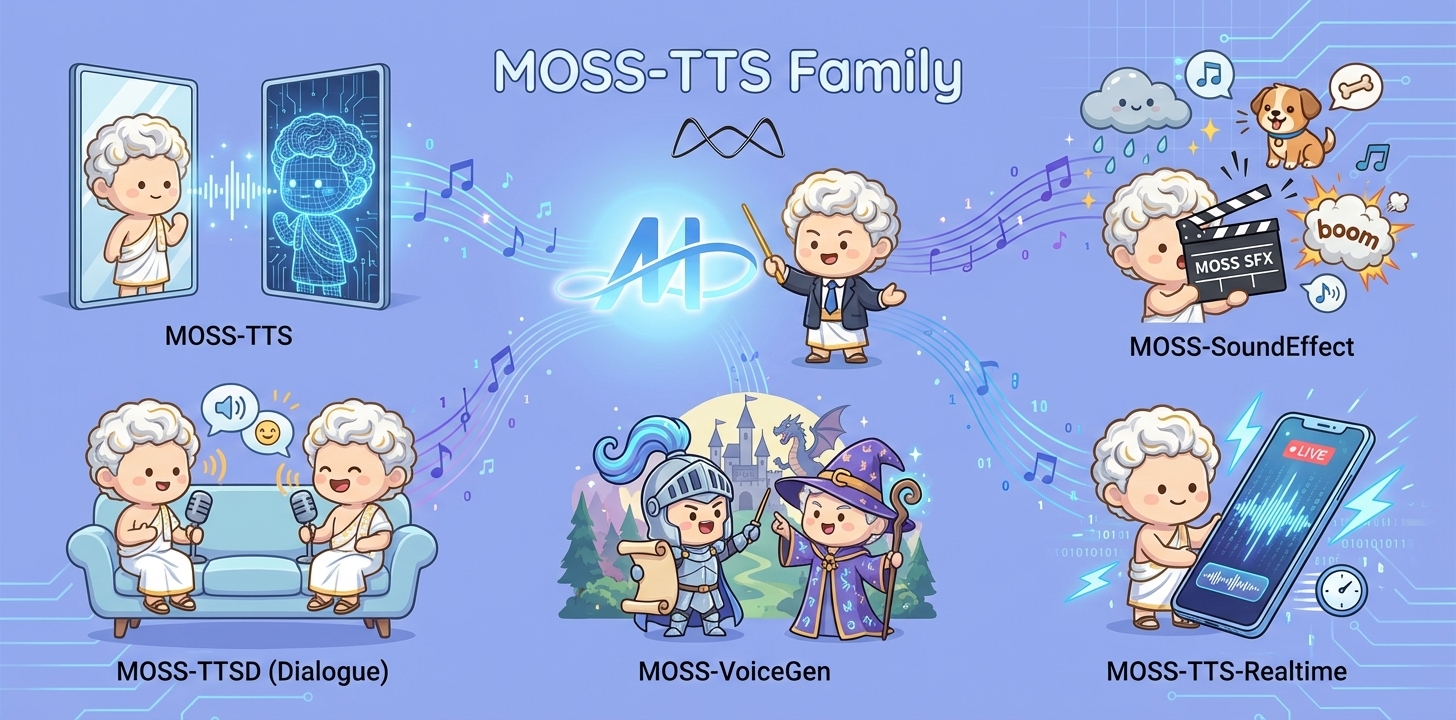
MOSS-TTS Family
Overview
MOSS‑TTS Family is an open‑source speech and sound generation model family from MOSI.AI and the OpenMOSS team. It is designed for high‑fidelity, high‑expressiveness, and complex real‑world scenarios, covering stable long‑form speech, multi‑speaker dialogue, voice/character design, environmental sound effects, and real‑time streaming TTS.
Introduction
When a single piece of audio needs to sound like a real person, pronounce every word accurately, switch speaking styles across content, remain stable over tens of minutes, and support dialogue, role‑play, and real‑time interaction, a single TTS model is often not enough. The MOSS‑TTS Family breaks the workflow into five production‑ready models that can be used independently or composed into a complete pipeline.
- MOSS‑TTS: MOSS-TTS is the flagship production TTS foundation model, centered on high-fidelity zero-shot voice cloning with controllable long-form synthesis, pronunciation, and multilingual/code-switched speech. It serves as the core engine for scalable narration, dubbing, and voice-driven products.
- MOSS‑TTSD: MOSS-TTSD is a production long-form dialogue model for expressive multi-speaker conversational audio at scale. It supports long-duration continuity, turn-taking control, and zero-shot voice cloning from short references for podcasts, audiobooks, commentary, dubbing, and entertainment dialogue.
- MOSS‑VoiceGenerator: MOSS-VoiceGenerator is an open-source voice design model that creates speaker timbres directly from free-form text, without reference audio. It unifies timbre design, style control, and content synthesis, and can be used standalone or as a voice-design layer for downstream TTS.
- MOSS‑SoundEffect: MOSS-SoundEffect is a high-fidelity text-to-sound model with broad category coverage and controllable duration for real content production. It generates stable audio from prompts across ambience, urban scenes, creatures, human actions, and music-like clips for film, games, interactive media, and data synthesis.
- MOSS‑TTS‑Realtime: MOSS-TTS-Realtime is a context-aware, multi-turn streaming TTS model for real-time voice agents. By conditioning on dialogue history across both text and prior user acoustics, it delivers low-latency synthesis with coherent, consistent voice responses across turns.
Released Models
MOSS Voice Generator Model Card
MOSS Voice Generator is an open-source voice generation system designed to enable the creation of custom speaker timbres from free-form textual descriptions. This model allows users to generate voices that reflect specific characters, personalities, and emotions. It is particularly notable for its ability to produce speech with natural-sounding emotional expressiveness, providing a realistic and nuanced listening experience. As an open-source tool, MOSS Voice Generator is suitable for a variety of applications, such as audiobooks, game dubbing, role-playing agents, and conversational assistants.
1. Overview
1.1 TTS Family Positioning
MOSS Voice Generator is a high-fidelity voice design tool within the broader TTS Family. It specializes in crafting expressive and natural-sounding voices from textual descriptions. Unlike traditional TTS systems relying on predefined voices or reference audio, MOSS Voice Generator enables zero-shot voice design, allowing for the creation of customized voices for a variety of applications, such as characters, audiobooks, games, or virtual assistants. Additionally, it can serve as a voice design layer for other TTS systems, addressing the challenge of finding suitable reference audio and improving integration and performance.
Key Capabilities
- Highly expressive emotional delivery: Aimed at generating voices with dynamic and nuanced emotional performances, allowing for natural shifts in tone, pace, and emotion.
- Human-Like Naturalness : Indistinguishable from real human speech with authentic breathing, pauses, and vocal nuances
- Multilingual Support : High-quality synthesis in Chinese and English
1.2 Model Architecture
MOSS Voice Generator employs MossTTSDelay architecture (see moss_tts_delay/README.md for more details), where voice description instructions and the text to be synthesized are concatenated and jointly tokenized as input to drive speech generation, enabling unified modeling of timbre design, style control, and content synthesis. Through instruction-timbre alignment, the model learns the correspondence between textual descriptions and acoustic features, allowing it to generate high-fidelity speech with target timbre, emotion, and style directly from free-form text prompts—without requiring any reference audio.
1.3 Released Model
Recommended decoding hyperparameters
2. Quick Start
Environment Setup
We recommend a clean, isolated Python environment with Transformers 5.0.0 to avoid dependency conflicts.
Install all required dependencies:
(Optional) Install FlashAttention 2
For better speed and lower GPU memory usage, you can install FlashAttention 2 if your hardware supports it.
If your machine has limited RAM and many CPU cores, you can cap build parallelism:
Notes:
- Dependencies are managed in
pyproject.toml, which currently pins torch==2.9.1+cu128 and torchaudio==2.9.1+cu128.
- If FlashAttention 2 fails to build on your machine, you can skip it and use the default attention backend.
- FlashAttention 2 is only available on supported GPUs and is typically used with
torch.float16 or torch.bfloat16.
Basic Usage
Input Types
UserMessage
Generation Hyperparameters
Note: MOSS-Voice-Generator is sensitive to decoding hyperparameters. See Released Models for recommended defaults.
3. Performance
MOSS Voice Generator demonstrates significant advantages in subjective evaluation. Using 160 internal test samples covering diverse voice styles, we established three independent evaluation dimensions: (1) Overall Preference - Which voice would you choose? (2) Instruction Following - Which audio best follows the instructions (gender, age, tone, emotion, accent, speed)? (3) Naturalness - Which audio sounds most like real human speech? Results show that MOSS Voice Generator outperforms all TTS systems that support zero predefined voices and customizable preview text across these three dimensions.