MOSS-TTS Family
Overview
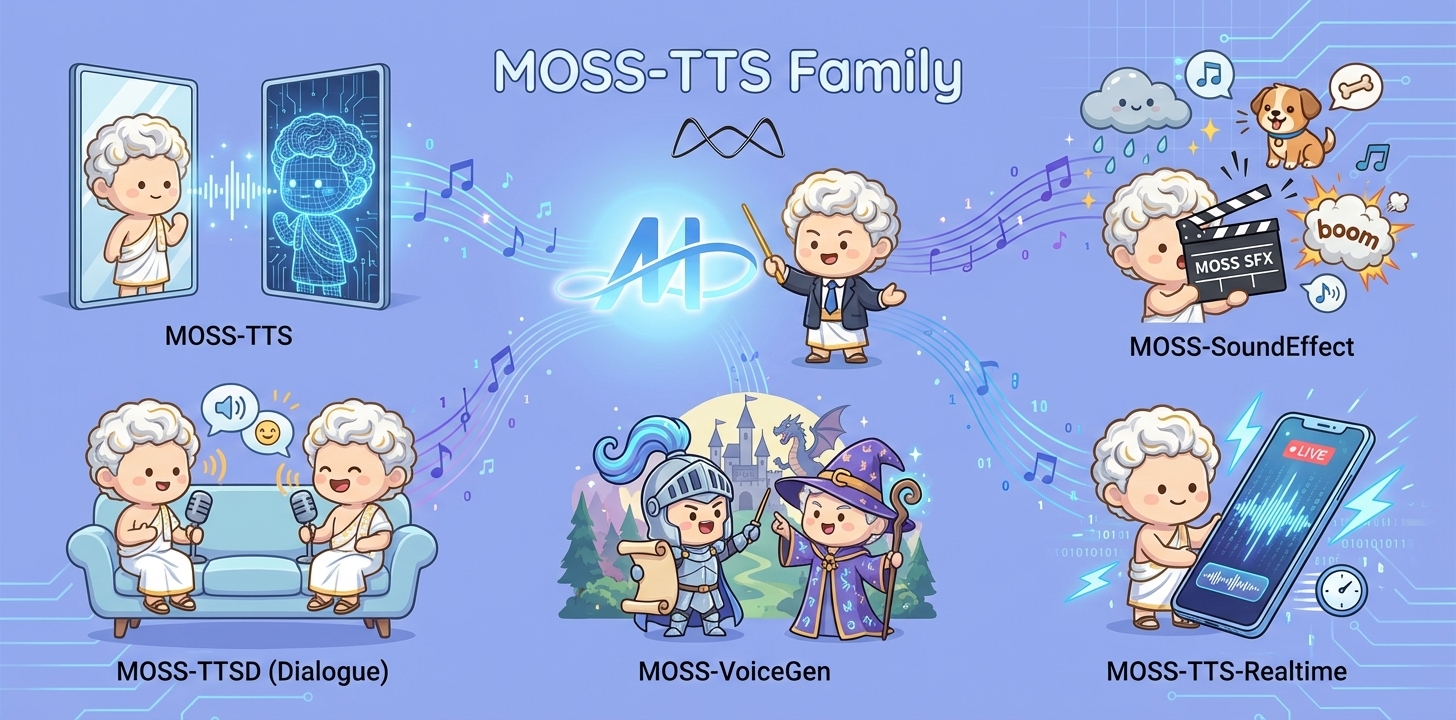
MOSS‑TTS Family is an open‑source speech and sound generation model family from MOSI.AI and the OpenMOSS team. It is designed for high‑fidelity, high‑expressiveness, and complex real‑world scenarios, covering stable long‑form speech, multi‑speaker dialogue, voice/character design, environmental sound effects, and real‑time streaming TTS.
Introduction
When a single piece of audio needs to sound like a real person, pronounce every word accurately, switch speaking styles across content, remain stable over tens of minutes, and support dialogue, role‑play, and real‑time interaction, a single TTS model is often not enough. The MOSS‑TTS Family breaks the workflow into five production‑ready models that can be used independently or composed into a complete pipeline.
- MOSS‑TTS: The flagship production model featuring high fidelity and optimal zero-shot voice cloning. It supports long-speech generation, fine-grained control over Pinyin, phonemes, and duration, as well as multilingual/code-switched synthesis.
- MOSS‑TTSD: A spoken dialogue generation model for expressive, multi-speaker, and ultra-long dialogues. The new v1.0 version achieves industry-leading performance on objective metrics and outperformed top closed-source models like Doubao and Gemini 2.5-pro in subjective evaluations. You can visit the MOSS-TTSD repository for details.
- MOSS‑VoiceGenerator: An open-source voice design model capable of generating diverse voices and styles directly from text prompts, without any reference speech. It unifies voice design, style control, and synthesis, functioning independently or as a design layer for downstream TTS. Its performance surpasses other top-tier voice design models in arena ratings.
- MOSS‑TTS‑Realtime: A multi-turn context-aware model for real-time voice agents. It uses incremental synthesis to ensure natural and coherent replies, making it ideal for building low-latency voice agents when paired with text models. The TTFB (Time To First Byte) of MOSS-TTS-Realtime reaches 180 ms, and the $T_{\text{LLM-first-sentence}} + T_{\text{MOSS-TTS-Realtime-TTFB}}$ is 377 ms.
- MOSS‑SoundEffect: A content creation model specialized in sound effect generation with wide category coverage and controllable duration. It generates audio for natural environments, urban scenes, biological sounds, human actions, and musical fragments, suitable for film, games, and interactive experiences.
Model Architecture
We train MossTTSDelay and MossTTSLocal as complementary baselines under one training/evaluation setup: Delay emphasizes long-context stability, inference speed, and production readiness, while Local emphasizes lightweight flexibility and strong objective performance for streaming-oriented systems. Together they provide reproducible references for deployment and research.
MossTTSRealtime is not a third comparison baseline; it is a capability-driven design for voice agents. By modeling multi-turn context from both prior text and user acoustics, it delivers low-latency streaming speech that stays coherent and voice-consistent across turns.
Released Models
Supported Languages
MOSS-TTS, MOSS-TTSD and MOSS-TTS-Realtime currently supports 20 languages:
MOSS-TTS
1. Overview
1.1 TTS Family Positioning
MOSS-TTS is the flagship base model in our open-source TTS Family. It is designed as a production-ready synthesis backbone that can serve as the primary high-quality engine for scalable voice applications, and as a strong research baseline for controllable TTS and discrete audio token modeling.
Design goals
- Production readiness: robust voice cloning with stable, on-brand speaker identity at scale
- Controllability: duration and pronunciation controls that integrate into real workflows
- Long-form stability: consistent identity and delivery for extended narration
- Multilingual coverage: multilingual and code-switched synthesis as first-class capabilities
1.2 Key Capabilities
MOSS-TTS delivers state-of-the-art quality while providing the fine-grained controllability and long-form stability required for production-grade voice applications, from zero-shot cloning and hour-long narration to token- and phoneme-level control across multilingual and code-switched speech.
-
State-of-the-art evaluation performance — top-tier objective and subjective results across standard TTS benchmarks and in-house human preference testing, validating both fidelity and naturalness.
-
Zero-shot Voice Cloning (Voice Clone) — clone a target speaker’s timbre (and part of speaking style) from short reference audio, without speaker-specific fine-tuning.
-
Ultra-long Speech Generation (up to 1 hour) — support continuous long-form speech generation for up to one hour in a single run, designed for extended narration and long-session content creation.
-
Token-level Duration Control — control pacing, rhythm, pauses, and speaking rate at token resolution for precise alignment and expressive delivery.
-
Phoneme-level Pronunciation Control — supports:
- pure Pinyin input
- pure IPA phoneme input
- mixed Chinese / English / Pinyin / IPA input in any combination
-
Multilingual support — high-quality multilingual synthesis with robust generalization across languages and accents.
-
Code-switching — natural mixed-language generation within a single utterance (e.g., Chinese–English), with smooth transitions, consistent speaker identity, and pronunciation-aware rendering on both sides of the switch.
1.3 Model Architecture
MOSS-TTS includes two complementary architectures, both trained and released to explore different performance/latency tradeoffs and to support downstream research.
Architecture A: Delay Pattern (MossTTSDelay)
- Single Transformer backbone with (n_vq + 1) heads.
- Uses delay scheduling for multi-codebook audio tokens.
- Strong long-context stability, efficient inference, and production-friendly behavior.
Architecture B: Global Latent + Local Transformer (MossTTSLocal)
- Backbone produces a global latent per time step.
- A lightweight Local Transformer emits a token block per step.
- Streaming-friendly with simpler alignment (no delay scheduling).
Why train both?
- Exploration of architectural potential and validation across multiple generation paradigms.
- Different tradeoffs: Delay pattern tends to be faster and more stable for long-form synthesis; Local is smaller and excels on objective benchmarks.
- Open-source value: two strong baselines for research, ablation, and downstream innovation.
For full details, see:
1.4 Released Models
Recommended decoding hyperparameters (per model)
Note: max_new_tokens controls duration. At 12.5 tokens per second, 1s ≈ 12.5 tokens.
2. Quick Start
Environment Setup
We recommend a clean, isolated Python environment with Transformers 5.0.0 to avoid dependency conflicts.
Install all required dependencies:
(Optional) Install FlashAttention 2
For better speed and lower GPU memory usage, you can install FlashAttention 2 if your hardware supports it.
If your machine has limited RAM and many CPU cores, you can cap build parallelism:
Notes:
- Dependencies are managed in
pyproject.toml, which currently pins torch==2.9.1+cu128 and torchaudio==2.9.1+cu128.
- If FlashAttention 2 fails to build on your machine, you can skip it and use the default attention backend.
- FlashAttention 2 is only available on supported GPUs and is typically used with
torch.float16 or torch.bfloat16.
Basic Usage
Tip: For evaluation and research purposes, we recommend using MOSS-TTSLocal-1.7B.
MOSS-TTS provides a convenient generate interface for rapid usage. The examples below cover:
- Direct generation (Chinese / English / Pinyin / IPA)
- Voice cloning
- Duration control
Continuation + Voice Cloning (Prefix Audio + Text)
MOSS-TTS supports continuation-based cloning: provide a prefix audio clip in the assistant message, and make sure the prefix transcript is included in the text. The model continues in the same speaker identity and style.
Input Types
UserMessage
AssistantMessage
Generation Hyperparameters (MOSS-TTS-Local)
MOSS-TTSLocal utilizes DelayGenerationConfig to manage hierarchical sampling. Due to the Progressive Sequence Dropout training mechanism, the model supports variable bitrate inference by adjusting the RVQ depth.
Pinyin Input
Use tone-numbered Pinyin such as ni3 hao3 wo3 men1. You can convert Chinese text with pypinyin, then adjust tones for pronunciation control.
IPA Input
Use /.../ to wrap IPA sequences so they are distinct from normal text. You can use DeepPhonemizer to convert English paragraphs or words into IPA sequences.
3. Evaluation
MOSS-TTS achieved state-of-the-art results on the open-source zero-shot TTS benchmark Seed-TTS-eval, not only surpassing all open-source models but also rivaling the most powerful closed-source models.