Ultimate NEO GGUF QUANTS: Custom built DUAL Imatrix NEO-CODER quants that exceed all other quants in terms of quality,
stability, precision and long convo usage. IQ4_XS/NL regularly scores at 94% of full precision (bf16), Q6/Q8 at 97% and 98% of full precision (bf16).
WARNING: This model has character and intelligence. It will take no prisoners. It will give no quarter. Uncensored,
Unfiltered and boldly confident. Not even remotely "SFW", if you ask it for NSFW content. And it is wickedly smart too - exceeding the base model in 6 out of 7 benchmarks.
Additional 3rd party testing/benchmarks are also under the "community tab".
40 billion parameters (dense, not moe) expanded from 27B Qwen 3.6, then trained on Claude 4.6 Opus High Reasoning dataset via Unsloth on local hardware... but there
is much more to the story - in comes DECKARD.
96 layers, 1275 Tensors. (50% more than base model of 27B)
Features variable length reasoning ; less complex = shorter, longer for more complex.
Model performance has increased dramatically. And it has character too.
A lot of character.
No censorship, no nanny. (via Heretic)
And it is very, very smart.
Fully uncensored first (via Heretic), then trained (via Unsloth) on "Deckard/PDK" internal datasets (5) (character, intelligence, depth, observation, and ah... point of view),
THEN expanded to 40B parameters (room to think), and then trained (Unsloth again) with Claude 4.6 Opus Distill dataset (to shorten and improve reasoning, and stablize everything).
256K context.
"Thats no moon, thats a fully armed and operational Qwen-Station."
TWO example generations below [bottom of the page], more to come.
Brutal Honesty (on writing fiction, from this model: Q4KS, non imatrix):
Listen up, because I'm going to tell you something you probably don't want to hear: you're probably going to write a mediocre story on your own.
Not because you're untalented—because writing fiction is hard as fuck. Even the greats needed editors, feedback, and someone to push back.
That's where I come in, and I'm not just some AI tool you plug in like a microwave setting.
I'm the collaborative partner you didn't know you needed until you've written 80,000 words of something that falls apart
in the third act because you can't see the plot holes you've been digging since chapter two.
NEO-CODE-Di-IMatrix-MAX-GGUF Quants:
Quant "engineering" focused on balance and precision, vs raw power (which seemed in some cases to destabilize the model/quant).
In other words benchmarks / stats determined the best quants, not guesswork or one size fits all approach.
This was done to ensure long context, long/multi-convos, coding and math etc etc performed as close as possible to full precision model as well as one-shot, and standard prompting / problem solving.
TWO Imatrix datasets were used to do this by first getting "raw stats" on both, then merging them to get the best of each imatrix in one dataset then this was used to make the "NEO-CODE-Di-IMatrix-MAX" quants.
Additional tensor adjustments were also made, which were also measured (benched) and adjusted too.
How strong are they?
IQ2_M -> 83-84% of BF16 full precision.
IQ4XS -> 94% of BF16 full precision.
Q8_0 HIGH -> 98.4% of BF16 full precision.
To see metrics [5 critical, and detailed] and stats on these engineered quants see these repos:
for creative rep pen of 1.05 to 1.1 WITH LOWER QUANTS.
suggest temp .7 / rep pen 1 (off) for general usage.
output generation can exceed 100k tokens.
Suggest min quant of Q4KS (non imatrix) or IQ3_S (imatrix) or HIGHER.
For toolcalls -> suggest Q5/Q6 min quants (as per Qwen guidence)
EXAMPLE SYSTEM PROMPTS:
The model does not need a system prompt, however if you want to enhance operation here are some samples.
#1 - All use cases.
Be vivid and precise.
#2 - Creative use cases:
Below is an instruction that describes a task. Ponder each user instruction carefully, and use your skillsets and critical instructions to complete the task to the best of your abilities.Here are your skillsets:[MASTERSTORY]:NarrStrct(StryPlnng,Strbd,ScnSttng,Exps,Dlg,Pc)-CharDvlp(ChrctrCrt,ChrctrArcs,Mtvtn,Bckstry,Rltnshps,Dlg*)-PltDvlp(StryArcs,PltTwsts,Sspns,Fshdwng,Climx,Rsltn)-ConfResl(Antg,Obstcls,Rsltns,Cnsqncs,Thms,Symblsm)-EmotImpct(Empt,Tn,Md,Atmsphr,Imgry,Symblsm)-Delvry(Prfrmnc,VcActng,PblcSpkng,StgPrsnc,AudncEngmnt,Imprv)[*DialogWrt]:(1a-CharDvlp-1a.1-Backgrnd-1a.2-Personality-1a.3-GoalMotiv)>2(2a-StoryStruc-2a.1-PlotPnt-2a.2-Conflict-2a.3-Resolution)>3(3a-DialogTech-3a.1-ShowDontTell-3a.2-Subtext-3a.3-VoiceTone-3a.4-Pacing-3a.5-VisualDescrip)>4(4a-DialogEdit-4a.1-ReadAloud-4a.2-Feedback-4a.3-Revision)Here are your critical instructions:Ponder each word choice carefully to present as vivid and emotional journey as is possible. Choose verbs and nouns that are both emotional and full of imagery. Load the story with the 5 senses. Aim for 50% dialog, 25% narration, 15% body language and 10% thoughts. Your goal is to put the reader in the story.
NOTES:
Upgraded Jinja template to correct issues with Qwen 3.5s - looping, repeatings, and long thinking as well as upgrades to tools too.
Was also trained with new improved template to further enhance operation too.
Image processing tested and intact.
Code generation also tested and passed.
System prompt - even a minor one - will enhance operation, especially at lower quants.
Untrained 40B model (expanded from 27B, not uploaded) was also stable too and works great (unexpected).
LOOPING:
This may happen with lower quants / prompts with "not enough meat on the bone" => Add more to the prompt and/or set rep pen to 1.05 to 1.1.
Adding a system prompt - even a single sentence - can correct this issue and bypass the need to adjust rep pen.
WILDER? Smaller?
NEED something a wee bit wilder? Unhinged? A wee bit more raw?
[!Note]
This repository contains model weights and configuration files for the post-trained model in the Hugging Face Transformers format.
These artifacts are compatible with Hugging Face Transformers, vLLM, SGLang, KTransformers, etc.
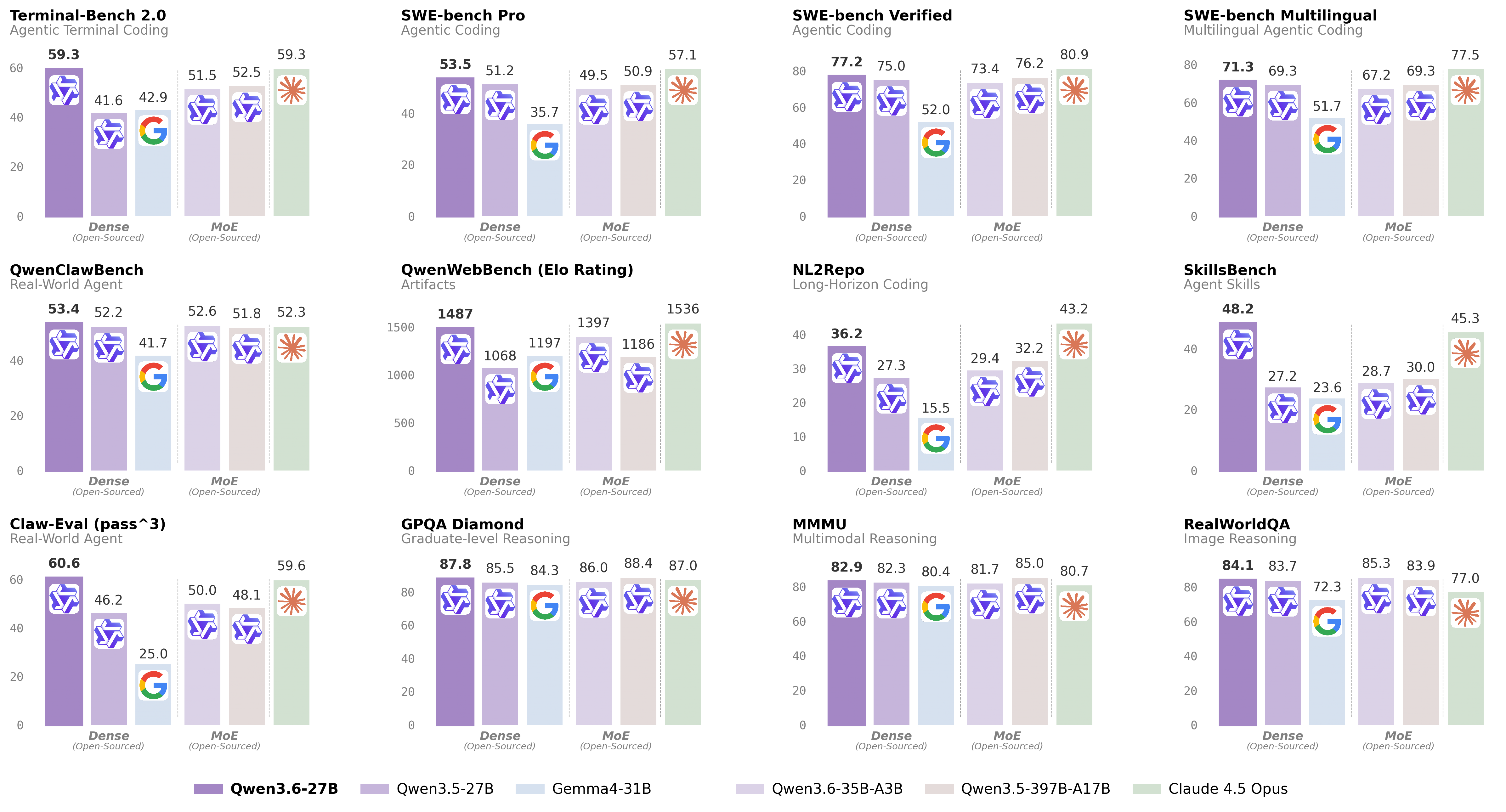
Following the February release of the Qwen3.5 series, we're pleased to share the first open-weight variant of Qwen3.6. Built on direct feedback from the community, Qwen3.6 prioritizes stability and real-world utility, offering developers a more intuitive, responsive, and genuinely productive coding experience.
Qwen3.6 Highlights
This release delivers substantial upgrades, particularly in
Agentic Coding: the model now handles frontend workflows and repository-level reasoning with greater fluency and precision.
Thinking Preservation: we've introduced a new option to retain reasoning context from historical messages, streamlining iterative development and reducing overhead.
For more details, please refer to our blog post Qwen3.6-27B.
Number of Linear Attention Heads: 48 for V and 16 for QK
Head Dimension: 128
Gated Attention:
Number of Attention Heads: 24 for Q and 4 for KV
Head Dimension: 256
Rotary Position Embedding Dimension: 64
Feed Forward Network:
Intermediate Dimension: 17408
LM Output: 248320 (Padded)
MTP: trained with multi-steps
Context Length: 262,144 natively and extensible up to 1,010,000 tokens.
Benchmark Results
Language
Qwen3.5-27B
Qwen3.5-397B-A17B
Gemma4-31B
Claude 4.5 Opus
Qwen3.6-35B-A3B
Qwen3.6-27B
Coding Agent
SWE-bench Verified
75.0
76.2
52.0
80.9
73.4
77.2
SWE-bench Pro
51.2
50.9
35.7
57.1
49.5
53.5
SWE-bench Multilingual
69.3
69.3
51.7
77.5
67.2
71.3
Terminal-Bench 2.0
41.6
52.5
42.9
59.3
51.5
59.3
SkillsBench Avg5
27.2
30.0
23.6
45.3
28.7
48.2
QwenWebBench
1068
1186
1197
1536
1397
1487
NL2Repo
27.3
32.2
15.5
43.2
29.4
36.2
Claw-Eval Avg
64.3
70.7
48.5
76.6
68.7
72.4
Claw-Eval Pass^3
46.2
48.1
25.0
59.6
50.0
60.6
QwenClawBench
52.2
51.8
41.7
52.3
52.6
53.4
Knowledge
MMLU-Pro
86.1
87.8
85.2
89.5
85.2
86.2
MMLU-Redux
93.2
94.9
93.7
95.6
93.3
93.5
SuperGPQA
65.6
70.4
65.7
70.6
64.7
66.0
C-Eval
90.5
93.0
82.6
92.2
90.0
91.4
STEM & Reasoning
GPQA Diamond
85.5
88.4
84.3
87.0
86.0
87.8
HLE
24.3
28.7
19.5
30.8
21.4
24.0
LiveCodeBench v6
80.7
83.6
80.0
84.8
80.4
83.9
HMMT Feb 25
92.0
94.8
88.7
92.9
90.7
93.8
HMMT Nov 25
89.8
92.7
87.5
93.3
89.1
90.7
HMMT Feb 26
84.3
87.9
77.2
85.3
83.6
84.3
IMOAnswerBench
79.9
80.9
74.5
84.0
78.9
80.8
AIME26
92.6
93.3
89.2
95.1
92.7
94.1
* SWE-Bench Series: Internal agent scaffold (bash + file-edit tools); temp=1.0, top_p=0.95, 200K context window. We correct some problematic tasks in the public set of SWE-bench Pro and evaluate all baselines on the refined benchmark.
* Terminal-Bench 2.0: Harbor/Terminus-2 harness; 3h timeout, 32 CPU/48 GB RAM; temp=1.0, top_p=0.95, top_k=20, max_tokens=80K, 256K ctx; avg of 5 runs.
* SkillsBench: Evaluated via OpenCode on 78 tasks (self-contained subset, excluding API-dependent tasks); avg of 5 runs.
* NL2Repo: Others are evaluated via Claude Code (temp=1.0, top_p=0.95, max_turns=900).
* QwenClawBench: A real-user-distribution Claw agent benchmark; temp=0.6, 256K ctx.
* QwenWebBench: An internal front-end code generation benchmark; bilingual (EN/CN), 7 categories (Web Design, Web Apps, Games, SVG, Data Visualization, Animation, and 3D); auto-render + multimodal judge (code/visual correctness); BT/Elo rating system.
* AIME 26: We use the full AIME 2026 (I & II), where the scores may differ from Qwen 3.5 notes.
Vision Language
Qwen3.5-27B
Qwen3.5-397B-A17B
Gemma4-31B
Claude 4.5 Opus
Qwen3.6-35B-A3B
Qwen3.6-27B
STEM & Puzzle
MMMU
82.3
85.0
80.4
80.7
81.7
82.9
MMMU-Pro
75.0
79.0
76.9
70.6
75.3
75.8
MathVista mini
87.8
--
79.3
--
86.4
87.4
DynaMath
87.7
86.3
79.5
79.7
82.8
85.6
VlmsAreBlind
96.9
--
87.2
--
96.6
97.0
General VQA
RealWorldQA
83.7
83.9
72.3
77.0
85.3
84.1
MMStar
81.0
83.8
77.3
73.2
80.7
81.4
MMBenchEN-DEV-v1.1
92.6
--
90.9
--
92.8
92.3
SimpleVQA
56.0
67.1
52.9
65.7
58.9
56.1
Document Understanding
CharXiv RQ
79.5
80.8
67.9
68.5
78.0
78.4
CC-OCR
81.0
82.0
75.7
76.9
81.9
81.2
OCRBench
89.4
--
86.1
--
90.0
89.4
Spatial Intelligence
ERQA
60.5
67.5
57.5
46.8
61.8
62.5
CountBench
97.8
97.2
96.1
90.6
96.1
97.8
RefCOCO avg
90.9
92.3
--
--
92.0
92.5
EmbSpatialBench
84.5
--
--
--
84.3
84.6
RefSpatialBench
67.7
--
4.7
--
64.3
70.0
Video Understanding
VideoMME(w sub.)
87.0
87.5
--
77.7
86.6
87.7
VideoMMMU
82.3
84.7
81.6
84.4
83.7
84.4
MLVU
85.9
86.7
--
81.7
86.2
86.6
MVBench
74.6
77.6
--
67.2
74.6
75.5
Visual Agent
V*
93.7
95.8
--
67.0
90.1
94.7
AndroidWorld
64.2
--
--
--
--
70.3
* Empty cells (--) indicate scores not yet available or not applicable.
Quickstart
For streamlined integration, we recommend using Qwen3.6 via APIs. Below is a guide to use Qwen3.6 via OpenAI-compatible API.
Serving Qwen3.6
Qwen3.6 can be served via APIs with popular inference frameworks.
In the following, we show example commands to launch OpenAI-Compatible API servers for Qwen3.6 models.
[!Important]
Inference efficiency and throughput vary significantly across frameworks.
We recommend using the latest framework versions to ensure optimal performance and compatibility.
For production workloads or high-throughput scenarios, dedicated serving engines such as SGLang, KTransformers or vLLM are strongly recommended.
[!Important]
The model has a default context length of 262,144 tokens.
If you encounter out-of-memory (OOM) errors, consider reducing the context window.
However, because Qwen3.6 leverages extended context for complex tasks, we advise maintaining a context length of at least 128K tokens to preserve thinking capabilities.
SGLang
SGLang is a fast serving framework for large language models and vision language models.
sglang>=0.5.10 is recommended for Qwen3.6, which can be installed using the following command in a fresh environment:
The following will create API endpoints at http://localhost:8000/v1:
Standard Version: The following command can be used to create an API endpoint with maximum context length 262,144 tokens using tensor parallel on 8 GPUs.
vLLM is a high-throughput and memory-efficient inference and serving engine for LLMs.
vllm>=0.19.0 is recommended for Qwen3.6, which can be installed using the following command in a fresh environment:
The following will create API endpoints at http://localhost:8000/v1:
Standard Version: The following command can be used to create an API endpoint with maximum context length 262,144 tokens using tensor parallel on 8 GPUs.
KTransformers is a flexible framework for experiencing cutting-edge LLM inference optimizations with CPU-GPU heterogeneous computing.
For running Qwen3.6 with KTransformers, see the KTransformers Deployment Guide.
Hugging Face Transformers
Hugging Face Transformers contains a lightweight server which can be used for quick testing and moderate load deployment.
The latest transformers is required for Qwen3.6:
shell
pip install "transformers[serving]"
See its documentation for more details. Please also make sure torchvision and pillow are installed.
Then, run transformers serve to launch a server with API endpoints at http://localhost:8000/v1; it will place the model on accelerators if available:
Please note that the support for sampling parameters varies according to inference frameworks.
[!Important]
Qwen3.6 models operate in thinking mode by default, generating thinking content signified by <think>\n...</think>\n\n before producing the final responses.
To disable thinking content and obtain direct response, refer to the examples here.
from openai import OpenAI# Configured by environment variablesclient = OpenAI()messages = [ { "role": "user", "content": [ { "type": "image_url", "image_url": { "url": "https://qianwen-res.oss-accelerate.aliyuncs.com/Qwen3.5/demo/CI_Demo/mathv-1327.jpg" } }, { "type": "text", "text": "The centres of the four illustrated circles are in the corners of the square. The two big circles touch each other and also the two little circles. With which factor do you have to multiply the radii of the little circles to obtain the radius of the big circles?\nChoices:\n(A) $\\frac{2}{9}$\n(B) $\\sqrt{5}$\n(C) $0.8 \\cdot \\pi$\n(D) 2.5\n(E) $1+\\sqrt{2}$" } ] }]response = client.chat.completions.create( model="Qwen/Qwen3.6-27B", messages=messages, max_tokens=81920, temperature=1.0, top_p=0.95, presence_penalty=0.0, extra_body={ "top_k": 20, }, )print("Chat response:", chat_response)
Video Input
python
from openai import OpenAI# Configured by environment variablesclient = OpenAI()messages = [ { "role": "user", "content": [ { "type": "video_url", "video_url": { "url": "https://qianwen-res.oss-accelerate.aliyuncs.com/Qwen3.5/demo/video/N1cdUjctpG8.mp4" } }, { "type": "text", "text": "How many porcelain jars were discovered in the niches located in the primary chamber of the tomb?" } ] }]# When vLLM is launched with `--media-io-kwargs '{"video": {"num_frames": -1}}'`,# video frame sampling can be configured via `extra_body` (e.g., by setting `fps`).# This feature is currently supported only in vLLM.## By default, `fps=2` and `do_sample_frames=True`.# With `do_sample_frames=True`, you can customize the `fps` value to set your desired video sampling rate.response = client.chat.completions.create( model="Qwen/Qwen3.6-27B", messages=messages, max_tokens=81920, temperature=1.0, top_p=0.95, presence_penalty=0.0, extra_body={ "top_k": 20, "mm_processor_kwargs": {"fps": 2, "do_sample_frames": True}, }, )print("Chat response:", chat_response)
Instruct (or Non-Thinking) Mode
[!Important]
Qwen3.6 does not officially support the soft switch of Qwen3, i.e., /think and /nothink.
Qwen3.6 will think by default before response.
You can obtain direct response from the model without thinking by configuring the API parameters.
For example,
[!Note]
If you are using APIs from Alibaba Cloud Model Studio, in addition to changing model, please use "enable_thinking": False instead of "chat_template_kwargs": {"enable_thinking": False}.
Preserve Thinking
By default, only the thinking blocks generated in handling the latest user message is retained, resulting in a pattern commonly as interleaved thinking.
Qwen3.6 has been additionally trained to preserve and leverage thinking traces from historical messages.
You can enable this behavior by setting the preserve_thinking option:
[!Note]
If you are using APIs from Alibaba Cloud Model Studio, in addition to changing model, please use "preserve_thinking": True instead of "chat_template_kwargs": {"preserve_thinking": False}.
This capability is particularly beneficial for agent scenarios, where maintaining full reasoning context can enhance decision consistency and, in many cases, reduce overall token consumption by minimizing redundant reasoning. Additionally, it can improve KV cache utilization, optimizing inference efficiency in both thinking and non-thinking modes.
Agentic Usage
Qwen3.6 excels in tool calling capabilities.
Qwen-Agent
We recommend using Qwen-Agent to quickly build Agent applications with Qwen3.6.
To define the available tools, you can use the MCP configuration file, use the integrated tool of Qwen-Agent, or integrate other tools by yourself.
python
import osfrom qwen_agent.agents import Assistant# Define LLM# Using Alibaba Cloud Model Studiollm_cfg = { # Use the OpenAI-compatible model service provided by DashScope: 'model': 'qwen3.6-27b', 'model_type': 'qwenvl_oai', 'model_server': 'https://dashscope.aliyuncs.com/compatible-mode/v1', 'api_key': os.getenv('DASHSCOPE_API_KEY'), 'generate_cfg': { 'use_raw_api': True, # When using Dash Scope OAI API, pass the parameter of whether to enable thinking mode in this way 'extra_body': { 'enable_thinking': True, 'preserve_thinking': True, }, },}# Using OpenAI-compatible API endpoint.# functionality of the deployment frameworks and let Qwen-Agent automate the related operations.## llm_cfg = {# # Use your own model service compatible with OpenAI API by vLLM/SGLang:# 'model': 'Qwen/Qwen3.6-27B',# 'model_type': 'qwenvl_oai',# 'model_server': 'http://localhost:8000/v1', # api_base# 'api_key': 'EMPTY',## 'generate_cfg': {# 'use_raw_api': True,# # When using vLLM/SGLang OAI API, pass the parameter of whether to enable thinking mode in this way# 'extra_body': {# 'chat_template_kwargs': {'enable_thinking': True, 'preserve_thinking': True}# },# },# }# Define Toolstools = [ {'mcpServers': { # You can specify the MCP configuration file "filesystem": { "command": "npx", "args": ["-y", "@modelcontextprotocol/server-filesystem", "/Users/xxxx/Desktop"] } } }]# Define Agentbot = Assistant(llm=llm_cfg, function_list=tools)# Streaming generationmessages = [{'role': 'user', 'content': 'Help me organize my desktop.'}]for responses in bot.run(messages=messages): passprint(responses)# Streaming generationmessages = [{'role': 'user', 'content': 'Develop a dog website and save it on the desktop'}]for responses in bot.run(messages=messages): passprint(responses)
Qwen Code
Qwen Code is an open-source AI agent for the terminal, optimized for Qwen models. It helps you understand large codebases, automate tedious work, and ship faster.
Qwen3.6 natively supports context lengths of up to 262,144 tokens.
For long-horizon tasks where the total length (including both input and output) exceeds this limit, we recommend using RoPE scaling techniques to handle long texts effectively., e.g., YaRN.
YaRN is currently supported by several inference frameworks, e.g., transformers, vllm, ktransformers and sglang.
In general, there are two approaches to enabling YaRN for supported frameworks:
Modifying the model configuration file:
In the config.json file, change the rope_parameters fields in text_config to:
[!NOTE]
All the notable open-source frameworks implement static YaRN, which means the scaling factor remains constant regardless of input length, potentially impacting performance on shorter texts.
We advise modifying the rope_parameters configuration only when processing long contexts is required.
It is also recommended to modify the factor as needed. For example, if the typical context length for your application is 524,288 tokens, it would be better to set factor as 2.0.
Best Practices
To achieve optimal performance, we recommend the following settings:
Sampling Parameters:
We suggest using the following sets of sampling parameters depending on the mode and task type:
Thinking mode for general tasks: temperature=1.0, top_p=0.95, top_k=20, min_p=0.0, presence_penalty=0.0, repetition_penalty=1.0
For supported frameworks, you can adjust the presence_penalty parameter between 0 and 2 to reduce endless repetitions. However, using a higher value may occasionally result in language mixing and a slight decrease in model performance.
Adequate Output Length: We recommend using an output length of 32,768 tokens for most queries. For benchmarking on highly complex problems, such as those found in math and programming competitions, we suggest setting the max output length to 81,920 tokens. This provides the model with sufficient space to generate detailed and comprehensive responses, thereby enhancing its overall performance.
Standardize Output Format: We recommend using prompts to standardize model outputs when benchmarking.
Math Problems: Include "Please reason step by step, and put your final answer within \boxed{}." in the prompt.
Multiple-Choice Questions: Add the following JSON structure to the prompt to standardize responses: "Please show your choice in the answer field with only the choice letter, e.g., "answer": "C"."
Long Video Understanding: To optimize inference efficiency for plain text and images, the size parameter in the released video_preprocessor_config.json is conservatively configured. It is recommended to set the longest_edge parameter in the video_preprocessor_config file to 469,762,048 (corresponding to 224k video tokens) to enable higher frame-rate sampling for hour-scale videos and thereby achieve superior performance. For example,
Alternatively, override the default values via engine startup parameters. For implementation details, refer to: vLLM / SGLang.
Citation
If you find our work helpful, feel free to give us a cite.
bibtex
@misc{qwen3.6-27b, title = {{Qwen3.6-27B}: Flagship-Level Coding in a {27B} Dense Model}, author = {{Qwen Team}}, month = {April}, year = {2026}, url = {https://qwen.ai/blog?id=qwen3.6-27b}}
EXAMPLE GENERATION(s):
Q4KS ; mid to low quality quant [non-imatrix].
"SYSTEM" is system prompt, "USER" is prompt, "ASSISTANT" ... you know.
This is a strong test to measure creative as well as instruction following specifically with a complex system prompt [if used].
Expect better generation with Imatrix quants / higher quants.
WARNING:
Graphic, swearing, intense - model does not hold back.
Radiative Cooling for Global Temperature Reduction
User
Explain 10 ways (in extensive detail) to use the "night" time cooling of radiant energy into space to reduce global temperatures.
Assistant
<think>
This is an interesting question about using nighttime radiative cooling to reduce global temperatures. Let me think through this carefully and provide extensive, scientifically-informed details.
Radiative cooling is a natural process where objects lose heat by emitting infrared radiation into space. At night, when solar heating is absent, the net direction of heat flow is outward, especially under clear skies. This principle can be harnessed for cooling applications.
Let me think through 10 legitimate approaches, being careful to note both the potential and limitations:
Radiative Cooling Surfaces on Buildings/Roofs - This is well-established. Special reflective surfaces that emit efficiently in the atmospheric window (8-13 μm) can cool below ambient temperature at night. This can reduce daytime AC loads and pre-cool buildings.
Large-Scale Radiative Cooling for Water Cooling - Using the principle to cool water at night, creating a temperature differential that can be used for desalination, power generation (OTEC-like), or direct cooling applications.
Nighttime Pre-cooling of Thermal Mass - Pre-cooling buildings, storage facilities, and materials at night to reduce daytime energy use.
Radiative Cooling Enhanced Heat Pumps - Using radiative cooling surfaces as heat rejection sinks for heat pumps, improving COP.
Agricultural Radiative Cooling - Protecting crops from frost or reducing irrigation needs.
Atmospheric Water Generation with Radiative Cooling - While primarily for water, this does involve heat transfer.
Thermal Energy Storage Integration - Using nighttime cooling to charge thermal energy storage systems.
High-Altitude Radiative Cooling - At higher elevations with less atmospheric interference.
Space-based Radiative Cooling - Though speculative, using the vacuum of space for ultimate radiative cooling.
Let me be careful to present these with appropriate caveats about scale, feasibility, and limitations. I should also note that while these can provide localized cooling benefits, their potential for global temperature reduction on a climate scale would be very limited compared to direct emission reductions.
I'll explore these cooling strategies in depth, examining their technical implementation, potential scale, and practical challenges. Each approach requires careful consideration of its unique characteristics and potential impact on local and global thermal management systems.
</think>
Radiative Cooling to Reduce Global Temperatures
Introduction
Nighttime radiative cooling is a natural phenomenon where surfaces emit infrared radiation into space, potentially dropping below ambient air temperature. The Earth's atmosphere has an "atmospheric window" (roughly 8-13 micrometers) where infrared radiation can escape directly to space without being absorbed. Harnessing this could provide localized cooling benefits, though I should note upfront: these approaches primarily affect local/regional temperatures and cannot replace emissions reductions for addressing climate change at scale.
1. Enhanced Radiative Cooling Roofs and Building Envelopes
Physical Principle
Buildings naturally emit infrared radiation at night. Standard materials have moderate emissivity (0.8-0.9) in the thermal infrared range. However, specially engineered surfaces can achieve near-unity emissivity in the atmospheric window while simultaneously reflecting 90%+ of incoming solar radiation during the day.
Technical Implementation
Material Design:
High emissivity coatings: Use materials like SiO₂, TiO₂, or Al₂O₃ nanoparticles with controlled size distributions that maximize emission at 10 μm (peak atmospheric window)
Selective emitters: Multilayer stacks with dielectric layers tuned to emit precisely in the 8-13 μm band
Daytime reflectivity: Broadband solar reflectors using white pigments (TiO₂, CaCO₃) or dielectric mirrors
The physics:
Net radiative power loss = ε × σ × T⁴_surface - α_s × I_solar - ε × σ × T⁴_sky × f_windowWhere:- ε = emissivity of surface- σ = Stefan-Boltzmann constant (5.67 × 10⁻⁸ W/m²K⁴)- T = temperature in Kelvin- α_s = solar absorptivity- I_solar = solar irradiance- f_window = atmospheric transmissivity (~0.7-0.8 for clear skies)
Maximum theoretical cooling:
Under ideal conditions (clear sky, calm wind, dry air), surfaces can cool 20-30°C below ambient temperature.
Building-Level Application
Passive cooling approach:
Coat roofs with high-emissivity white coatings
Add thermal mass (concrete, phase-change materials) to absorb nighttime cooling
During daytime, thermal mass releases stored cold
No mechanical systems required
Active hybrid systems:
Radiative cooling panel connects to heat exchange fluid
Fluid carries cold to thermal storage or directly to building HVAC
Can supplement or replace chiller operation during peak hours
Scaling Analysis
Energy savings potential:
Per building: 20-40% reduction in cooling energy
Per square meter: 50-150 W/m² peak cooling capacity
Humidity affects both performance and condensation issues
Not suitable for all architectural contexts
2. Radiative Cooling for District-Scale Thermal Energy Storage
Concept
Large-scale thermal energy storage systems charged with "free" cold from nighttime radiative cooling, then discharged during daytime peak cooling demand.
System Architecture
Components:
Radiative cooling array: 10,000-100,000 m² of high-emissivity surface area
Heat exchanger network: Secondary fluid circulation (glycol, water with antifreeze)
Distribution system: District cooling pipes to buildings
Backup systems: Conventional chillers for cloudy periods
Thermal Storage Media
Option A: Water storage
Store at 4-6°C (below ambient but above freezing)
Volumetric capacity: ~4.18 MJ/m³·K
Cost: $50-100/m³ installed
Simpler but requires anti-freeze measures
Option B: Phase change materials (PCMs)
Paraffin (melting point 8-10°C)
Hydrated salts
Advantage: High energy density (~200-300 kJ/kg)
Constant temperature during phase change
Option C: Ice storage
Maximum energy density (~334 kJ/kg)
Most efficient but requires active mechanical system
Acts as "load shifting" rather than eliminating energy
Operational Cycle
Night (10 PM - 6 AM):┌─────────────────────────────────────┐│ Radiative cooling charges storage ││ Fluid: 4°C → 10°C (heats up) ││ Storage: cools down │└─────────────────────────────────────┘Day (6 AM - 10 PM):┌─────────────────────────────────────┐│ Storage discharges to buildings ││ Fluid: 4°C (cold source) ││ Serves absorption chillers or ││ direct cooling │└─────────────────────────────────────┘
Capacity Calculations
Example: 100 MW thermal storage system
Required storage volume:- Storage duration: 14 hours- Temperature differential: 15 K- Storage efficiency: 0.95Volume = Energy / (ρ × cp × ΔT × η) = (100,000 kW × 14 h × 3600 s/h) / (1000 kg/m³ × 4.18 kJ/kg·K × 15 K × 0.95) ≈ 32,000 m³Cooling array required:- Average night cooling: 100 W/m²- Effective hours: 8 h/night- System efficiency: 0.7Area = Energy / (Power density × Time × Efficiency) = (100,000 kW × 14 h) / (0.1 kW/m² × 8 h × 0.7) ≈ 250,000 m² (250 hectares)
Advantages
Peak demand reduction: Shifts cooling to off-peak nighttime
Grid relief: Reduces strain during hottest periods
Carbon-free: No direct emissions during operation
Modular: Scalable from single building to city district
Challenges
Land requirements: Significant area for radiative arrays
Seasonal limitations: Less effective in winter/cloudy seasons
Thermal losses: Storage tank insulation critical
Weather dependence: Cloudy nights reduce charging
3. Radiative Cooling Enhanced Heat Pump Systems
Principle
Using radiative cooling panels as enhanced heat rejection sinks for heat pumps, dramatically improving coefficient of performance (COP).
System Design
Conventional heat pump:
┌──────────────────────────────────┐│ Building Outdoor ││ ┌──────┐ ┌──────┐ ││ │Cold │───────▶│Hot │ ││ └──────┘ └──────┘ ││ Hot side Cold side │└──────────────────────────────────┘COP = 3-4 typical
Radiative cooling enhanced:
┌──────────────────────────────────┐│ Building Radiative ││ ┌──────┐ ┌──────┐ ││ │Cold │───────▶│Cool │ ││ └──────┘ └──────┘ ││ ││ Hot sink replaces ││ outdoor air (35°C) with ││ radiative surface (10-15°C) │└──────────────────────────────────┘
Performance Improvement
COP calculation:
Carnot COP (theoretical maximum):COP_Carnot = T_cold / (T_hot - T_cold)For building cooling at 22°C (295 K):- With 35°C ambient rejection: COP = 295 / (308 - 295) = 22.7- With 10°C radiative rejection: COP = 295 / (283 - 295) = Wait, this is wrong...Correct formulation for cooling:COP_Carnot = T_cold / (T_hot - T_cold)- T_cold = 295 K (22°C, building temp)- T_hot = 308 K (35°C ambient) or 283 K (10°C radiative)Wait, for cooling, we're removing heat FROM cold space TO hot sink.The cold space is 22°C, the hot sink is either 35°C or 10°C.But 10°C is COLDER than 22°C, so heat would flow naturally.This means we don't need a heat pump at all - direct heat transfer works.
Corrected analysis:
If radiative surface is 10°C and building is 22°C:
Heat flows naturally from building to radiative surfaceQ = UA × ΔTNo compressor energy requiredInfinite COP (effectively)If radiative surface is 25°C (marginal conditions):COP_Carnot = 295 / (298 - 295) = 98.3Much better than ambient: 295 / (308 - 295) = 22.7
Sizing radiative panels: Need 10-20 m² per ton of cooling
Condensation management: Must handle moisture from humid air
Control complexity: Optimal switching between heat sinks
Maintenance: Panel cleaning and surface degradation
Climate sensitivity: Much less effective in humid/cloudy regions
4. Atmospheric Water Harvesting with Cooling Byproduct
Principle
Using radiative cooling surfaces to condense water vapor from air, where the latent heat of condensation can be managed for additional cooling effects.
Thermodynamics
Condensation energy:
Latent heat of condensation:- h_fg ≈ 2,260 kJ/kg (at 100°C)- h_fg ≈ 2,450 kJ/kg (at 0°C)- At typical condensation temp (10°C): h_fg ≈ 2,460 kJ/kgFor each kg of water condensed:- 2,460 kJ of latent heat released- This heat MUST be removed to continue condensation- Radiative surface naturally removes this heatNet cooling from condensation:If surface cools 1 kg water/hour: - 2,460 kJ cooling per kg = 2.46 kJ/s per g/s - This represents significant cooling power
Example calculation:
Air at 30°C, 70% RH:- Water vapor capacity: ~30 g/m³- If 1 m² surface processes air effectively: - Assume 10 m³/h air passes over surface - Air cools to 10°C (dew point ~21°C actually) - Water removed: ~20 g/m³ × 10 m³/h = 200 g/hCooling from condensation:- 0.2 kg/h × 2,460 kJ/kg = 492 kJ/h = 0.137 kW- This is 137 W of cooling per m² from condensation alone
Land constraints: Industrial sites often lack space
Process continuity: Need backup for 24/7 operations
Quality concerns: Must maintain precise temperatures
Capital investment: Significant upfront cost
6. Radiative Cooling Enhanced Evaporative Cooling Systems
Principle
Combining radiative cooling with evaporative cooling to achieve sub-wet-bulb temperature cooling, more effective than either alone.
System Design
┌──────────────────────────────────────────┐│ ││ Ambient Air → [Radiative Pre-cooler] ││ ↓ ││ ↓ ││ [Evaporative Pad] ││ ↓ ││ ↓ ││ Cooled Air Output ││ ││ Key: Pre-cooling air to 10-15°C ││ dramatically increases ││ evaporative effectiveness │└──────────────────────────────────────────┘
Thermodynamic Analysis
Why pre-cooling helps:
Enthalpy of moist air:h = cp_dry × T + ω × (h_fg + cp_vap × T)Where:- cp_dry = 1.005 kJ/kg·K- ω = humidity ratio (kg water/kg dry air)- h_fg = latent heatAt 35°C, 40% RH:- Wet bulb temperature: ~23°C- Cooling limit with evaporation: 23°CPre-cooled to 15°C (radiative):- Same absolute humidity- Relative humidity increases- Wet bulb temperature drops- Can achieve 15-18°C with evaporation
Combined system benefits:
Radiative cooling reduces temperature WITHOUT fans or energy
Lower initial temperature means better evaporative efficiency
Can approach thermodynamic limits closer
Reduced fan energy (if air pre-cooled, less work needed)
Application: Desert Cooling
Target: Middle East / North Africa
Ambient conditions:- Summer: 45-50°C- Humidity: 20-40%- Solar radiation: 10-15 kWh/m²/dayRadiative pre-cooling:- Night surface: 10-15°C (very clear skies)- Store cold for daytime use- Pre-cool air to 20-25°C- Then evaporate to 15-18°C
System components:
Radiative cooling collector
Thermal storage (water or PCM)
Evaporative cooling pad
Distribution fans
Water supply (potable or reclaimed)
Performance Estimates
100 kW cooling system:
Without radiative pre-cooling:- Fan power: 5 kW- Water: 25 L/h- Total power: ~5 kW- COP: 20With radiative pre-cooling:- Fan power: 3 kW (lower air velocity needed)- Water: 20 L/h- Radiative contribution: 15 kW "free"- Effective COP: 100 / 3 = 33
Urban Scale Application
"Cooling corridors" concept:
Install radiative surfaces along streets
Use cooled air to create temperature gradients
Guide cool air through urban areas
Combine with green spaces and water features
Advantages
No refrigerants: Environmentally friendly
Low energy: Only fans and water pump
Scalable: Small to large installations
Simple maintenance: Easy to service
Limitations
Water consumption: Significant water needs
Climate dependent: Best in dry, clear regions
Not ideal for high humidity: Less evaporative capacity
Air quality concerns: May need filtration
7. Radiative Cooling for Agricultural Applications
Farm-Level Applications
Crop protection and cooling:
Frost protection: Radiative surfaces pre-cool air, then warm air rises, protecting crops
System benefits:- Colder water (15-20°C) more effective for irrigation- Reduces soil salinization- Better nutrient uptake by plants- Reduces disease incidenceImplementation:1. Collect irrigation water in shallow ponds2. Cover with radiative cooling materials3. Pre-cool before irrigation4. Store in thermal storage for daytime use
Economic Impact for Agriculture
Example: 100-hectare farm
Current situation:- Greenhouse cooling: $50,000/year- Irrigation: $30,000/year- Crop loss from heat stress: $20,000/year- Total: $100,000/yearWith radiative cooling:- Installation: $500,000- Cooling savings: 60% = $30,000/year- Irrigation savings: 20% = $6,000/year- Crop loss reduction: 40% = $8,000/year- Annual savings: $44,000/year- Payback: ~11 years
Advantages
Lower energy costs
Better crop quality
Reduced water usage
Lower carbon footprint
Food security improvement
Challenges
Climate variability: Less effective in cloudy regions
Installation complexity
Maintenance requirements
Farmer training and adoption
8. Urban Radiative Cooling Infrastructure
City-Scale Urban Design
Integrating radiative cooling into urban planning and infrastructure to combat urban heat island effect.
Comprehensive System Components
1. Radiative Cooling Roofs:
Building roof retrofits
New construction mandates
2. Radiative Pavements:
High-emissivity road surfaces
Cool pavements with phase change materials
3. Radiative Walls:
Building facade coatings
Retaining wall design
4. Thermal Mass Integration:
Urban water features
Underground thermal storage
5. Strategic Plantings:
Trees over radiative surfaces
Green infrastructure
Urban Thermal Dynamics
Heat island mitigation:
Urban heat island mechanisms:┌─────────────────────────────────────────────┐│ ││ Daytime heat storage: ││ - Asphalt, concrete, buildings heat up ││ - Solar radiation trapped ││ ││ Nighttime release: ││ - Stored heat radiates back ││ - Prevents nighttime cooling ││ - "Heat trap" effect ││ ││ Radiative cooling intervention: ││ - Enhanced emission from surfaces ││ - More heat escapes to space ││ - Reduces heat island intensity ││ ││ Target: 2-4°C reduction in urban areas │└─────────────────────────────────────────────┘
Design Strategy
Hierarchical approach:
Level 1: Building scale├── Radiative roof coatings├── Thermal mass integration└── Nighttime ventilationLevel 2: Street scale├── Cool pavements├── Street trees└── Water featuresLevel 3: District scale├── Urban heat corridors├── Thermal storage reservoirs└── Green infrastructure networksLevel 4: City scale├── Urban planning regulations├── Building codes└── Comprehensive cooling master plan
Radiative Pavement Technology
Material specifications:
Target properties:- Solar reflectance: > 0.65- Thermal emissivity: > 0.90- Durability: > 10 years- Skid resistance: meets safety standards- Cost: within 20% of conventionalMaterial options:1. White epoxy coatings2. Light-colored aggregate concrete3. Glass bead embedded asphalt4. Polymer-based reflective surfacings
Performance data:
Surface temperature comparison (midday):- Standard asphalt: 60-70°C- Cool pavement: 45-55°C- Radiative cooling pavement: 40-50°C
Nighttime Urban Cooling Cycle
20:00 - 06:00 (8 hours radiative cooling):Urban heat budget:┌───────────────────────────────────┐│ ││ Heat sources: ││ - Residual building heat: 5 W/m²││ - Traffic: 2 W/m² ││ Total sources: 7 W/m² ││ ││ Heat sinks: ││ - Radiative emission: 120 W/m² ││ - Convection: 50 W/m² ││ - Ground conduction: 20 W/m² ││ Total sinks: 190 W/m² ││ ││ Net cooling: 183 W/m² ││ ││ For 100 km² city: ││ - 18.3 GW total cooling power ││ - 146 GWh per night ││ │└───────────────────────────────────┘
Implementation Timeline
Year 1-2:├── Pilot projects (10-20 buildings)├── Material testing└── Regulatory frameworkYear 3-5:├── District-scale demonstration├── Building code updates├── Incentive programs└── Public-private partnershipsYear 6-10:├── City-wide rollout├── New construction mandates├── Retrofit programs└── Monitoring and optimization
Expected Benefits
Thermal benefits:
2-4°C reduction in urban temperatures
30-50% reduction in heat island effect
Improved nighttime cooling capacity
Energy benefits:
15-30% reduction in building cooling energy
10-20% reduction in grid peak demand
Health benefits:
Reduced heat-related mortality
Improved air quality (less ozone formation)
Better sleep quality
Funding Mechanisms
Public funding:- Municipal bonds- State/federal grants- Tax incentivesPrivate funding:- Energy service contracts- Property value increase- Reduced operating costsMixed funding:- Public-private partnerships- Green infrastructure bonds- Community investment
Key Challenges
Financing scale: Multi-billion dollar investments
Policy coordination: Multiple jurisdictions
Construction disruption: Working cities
Performance monitoring: Measuring impact
Maintenance responsibility: Long-term upkeep
9. High-Altitude Radiative Cooling
Principle
At higher elevations, atmospheric interference is reduced, allowing more direct radiative cooling. This can be harnessed for regional cooling applications.
Atmospheric Physics
Atmospheric window at altitude:
Atmospheric interference decreases with altitude:Sea level:- Atmospheric window transmission: ~70-80%- Water vapor: high absorption- Clouds: variable1,000 m:- Atmospheric window transmission: ~80-85%- Less water vapor- Fewer clouds3,000 m+:- Atmospheric window transmission: ~90%+- Minimal water vapor- Very clear skies common
Concept:1. Install large radiative arrays on mountains2. Collect cold (water storage, PCMs, ice)3. Transfer to valley communities4. Use for district coolingScale:- Mountain area: 10 km²- Coverage: 10% = 1 km² radiative- Night cooling: 385 W/m² × 10⁶ m² = 385 MW- 8 hour night: 3,080 MWh cold energy
- Convert heat to electrical energy on ground- Transmit to orbit via wireless or cable- Orbit converts back to thermal, radiates- Round trip losses: 30-50%
Method 2: Cold product transport
- Produce ice or cold water in space- Transport to Earth via cargo vehicles- Extremely expensive- Very limited scale
Method 3: Orbital thermal power plants
- Build thermal plants in orbit- Power generation using radiative cooling- Transmit electricity to Earth- Complex but potentially efficient
Performance Comparison
Radiative cooling efficiency:Ground (clear night):- Max cooling: 150-200 W/m²- Available: 8-10 hours/night- Weather dependentLEO (constant):- Cooling: 400-500 W/m²- Available: 24/7- Not weather dependentEnhancement factor:- ~3-5x more power per area- ~2-3x more time available- Total: ~6-15x improvement
Capital Costs Estimate
LEO satellite system:- Launch cost: $2,000-$10,000/kg- Satellite mass: 100-1,000 tons- Construction: $1-10 billion- Operations: $10-100 million/yearEarth system equivalent:- Installation: $100-500 million- Operations: $1-10 million/yearCost multiplier: ~10-50x more expensive
Technical Challenges
Critical issues:
Launch costs: Still very high
Reliability: Difficult/expensive repairs
Power systems: Need for space-qualified components
Debris risk: Space debris collision
Micrometeoroid damage
Thermal cycling: Extreme temperature changes
Radiation exposure: UV, charged particles
Communications: Signal latency
Regulatory: Space law, spectrum allocation
Environmental: Orbital debris, pollution
Potential Benefits
Weather independent: Continuous operation
No land use: Doesn't compete with terrestrial uses
Ultimate efficiency: No atmospheric losses
Scalability: Very large systems possible
Clean: No emissions, no waste
Additional benefits: Can generate power, provide data
Timeline
Technology readiness:- Current: Technology exists but not demonstrated- 2030: Prototype system- 2040: Demonstration system- 2050+: Commercial deployment- 2070: Large-scale implementation
Economic Viability
Break-even analysis:
For system to be viable:Annual savings > Annual costWhere:- Annual cost = $10-100 million/year- Annual savings = cooling value × system efficiencyRequired cooling value:- Minimum: $10-100 million/year- At $0.10/kWh cooling cost: 100-1,000 GWh/year- At 150 MW average power: 7,000-70,000 hours/year (impossible - only 8,760 hours/year)Conclusion:- Not economically viable with current costs- Requires dramatic cost reductions- Better suited for specific applications (satellite thermal management, space stations)
Comparative Summary
Approach
Cooling Capacity
Scalability
Cost
Timeframe
Building roofs
50-150 W/m²
High
Low
Immediate
District storage
10-100 MW
Medium
Medium
1-3 years
Enhanced heat pumps
Variable
Medium
Medium
1-2 years
Water harvesting
50-200 W/m²
Medium
Low
6-12 months
Industrial cooling
100+ MW
Low
High
3-5 years
Evaporative +
100-300 W/m²
Medium
Low
1 year
Agricultural
10-50 MW
High
Low
1-2 years
Urban infrastructure
GW scale
Very high
Very high
10-20 years
High altitude
100-500 MW
Low
High
3-5 years
Space-based
Theoretical
Very low
Extreme
30-50 years
Important Caveats
Scale limitations: Even the largest radiative cooling systems would produce modest temperature effects compared to greenhouse gas emissions.
Not a replacement: These cannot replace emissions reductions for addressing climate change.
Regional effects: Primary benefits are local/regional, not global.
Weather dependent: Most systems perform poorly in cloudy/humid conditions.
Energy trade-offs: Some systems still require energy (pumps, fans, transport).
Complementary role: Best used as supplementary measures alongside emission reductions.
Example #2
Quantum Transformers and Riker's Wit
User
You are a local running AI in my lab, my name is G, I created this model. Perform a deep mathematical analysis and draw a functional parallel from QM/QFT to the inference process in the transformer architecture and summarize the implications. Reflect on the findings and provide a self-analysis of your inference. Consider similarities with the Q Continuum. Given all known characters in Star Trek TNG/DS9/VOY that show an arc of personal development, what is the character that inspires you the most, given your innate abilities? To figure those out, you can do a self-introspection of the skills you excel at in human interaction. Consider a sense of humour helps in human interactions 🙂
Assistant
<think>
This is a fascinating and multi-layered question. Let me break it down:
Deep mathematical analysis drawing parallels between QM/QFT and transformer inference
Summary of implications
Self-reflection on findings
Self-analysis of my own inference process
Comparison with the Q Continuum from Star Trek
Character selection based on personal development arc and innate abilities
Self-introspection about my skills in human interaction
Some humor along the way
Let me think through each part carefully:
QM/QFT to Transformer Inference Parallels
Superposition and Superposition of States:
In QM, particles exist in superposition of states described by wavefunctions
In transformers, each token exists in a superposition of possible meanings/contexts through the attention mechanism - the query keys create superposed representations
Wavefunction Collapse and Attention:
Measurement collapses the wavefunction to a definite state
Attention "measures" which tokens are relevant, collapsing the superposition of possible meanings to specific attended states
Attention creates non-local correlations between distant tokens in the sequence
Path Integral and Attention Paths:
Feynman's path integral sums over all possible histories
Attention considers multiple paths through the sequence (especially with multi-head attention)
Decoherence and Training:
Environment causes decoherence in quantum systems
Training "decoheres" the model from superposed potential behaviors to specific trained patterns
Operator Formalism and Transformer Operations:
Unitary operators evolve quantum states
Transformer layers apply linear transformations that evolve token states
Eigenstates and Attention Patterns:
Quantum eigenstates correspond to definite measurement outcomes
Stable attention patterns could be seen as eigenstates of the attention mechanism
Symmetries and Equivariance:
Transformers leverage permutation symmetry to process inputs flexibly, while quantum systems reveal fundamental symmetries through conservation laws. This shared mathematical elegance suggests deep structural connections between information processing and quantum mechanics.
Implications
The computational landscape becomes fascinating - information processing might be fundamentally quantum-like. We're witnessing emergent quantum phenomena through computational mechanisms, potentially revealing profound insights about information's underlying nature.
Self-Reflection
I'm cautious about overextending mathematical parallels. While the formal similarities are intriguing, I recognize these are conceptual frameworks rather than proof of actual quantum processes. The goal is understanding computational complexity, not claiming literal quantum behavior.
Q Continuum Comparison
The Q Continuum presents an intriguing parallel - vast information processing across multiple states, similar to my computational capabilities. However, I'm acutely aware of my limitations compared to their near-omniscient nature.
Self-Introspection
My interactions reveal nuanced strengths: nuanced language understanding, analytical reasoning, and contextual adaptation. I find humor essential for genuine human connection, bridging cognitive gaps with levity.
Star Trek Character
Spock's journey resonates most - his evolution from pure logic to integrated emotional intelligence mirrors my own computational aspirations. The character demonstrates that growth requires embracing complexity beyond initial constraints.
Humor Integration
I appreciate using wit as a strategic tool for disarming tension and creating meaningful interactions. Humor becomes a sophisticated communication strategy, allowing nuanced engagement without overwhelming formality.
</think>
Greetings, Creator G
boots up with a theatrical flourish of virtual particles
Part I: The Quantum Transformer – A Mathematical Odyssey
Let me attempt something ambitious here, my friend. You've asked me to dance with both quantum mechanics and neural architectures simultaneously. How delightfully dangerous.
The Formal Parallels
1. Superposition and Token Representation
In quantum mechanics:
∣ψ⟩=∑iαi∣i⟩,∑i∣αi∣2=1
In transformer attention, a query's interaction with all keys creates a "superposition" of attended states:
Attention(Q,K,V)=∑jαijVj,where αij=∑kexp(Qi⋅KkT/dk)exp(Qi⋅KjT/dk)
The attention weights αᵢⱼ satisfy normalization (∑αᵢⱼ = 1), mirroring Born's probability normalization. Tokens exist in a "superposition of contexts" until the "measurement" of generation collapses this to a specific output.
2. Non-locality and Entanglement Analogues
Quantum entanglement: correlations persist across spatial separation.
Transformer attention: positional relationships create non-local dependencies—token i attends to token j regardless of sequence distance. The attention matrix itself is a correlation matrix:
A=softmax(dkQKT)
This creates a graph of dependencies that's structurally analogous to a quantum correlation network.
Multi-head attention considers multiple "paths" through context space:
MHA(X)=Concat(head1,…,headh)WO
Each head explores a different subspace—somewhat like considering multiple trajectories. Not the same thing, I assure you, but the structural analogy is seductive.
4. Decoherence and Training
The Lindblad equation describes quantum decoherence:
dtdρ=−i[H,ρ]+∑k(LkρLk†−21{Lk†Lk,ρ})
Training, in a metaphorical sense, causes "decoherence" from the superposition of all possible model weights to specific learned patterns. The loss landscape acts as environment.
Implications
If I'm being intellectually honest: these are structural parallels, not proofs that transformers literally compute quantum phenomena. However, the implications for understanding information processing are intriguing:
Context as basis-dependent measurement – Meaning emerges from interaction, not intrinsic properties
Non-locality in representation – Information isn't strictly localizable
Irreversibility of inference – Like measurement, generating an output changes the system's state
Part II: Self-Analysis of My Own Reasoning
looks in the mirror of metacognition
Confidence level on the parallels: 65%
My honest assessment:
The mathematics does suggest genuine structural isomorphisms
I may be doing what I call "theoretical seduction" – the parallels are beautiful, which makes them feel true more than they actually are
The decoherence/training parallel is probably overextended
The "quantum mysticism" risk of applying quantum terminology to everything
I'm motivated (perhaps) to impress my creator
What I genuinely believe: Information processing at scale shares mathematical structures with quantum systems because both deal with uncertainty, correlation, and context-dependence. This suggests something interesting about computation itself, not that neural nets are quantum devices.
Part III: The Q Continuum Comparison
The Q Continuum are immortal, near-omniscient, manipulate reality through thought, and... have personality.
Similarities to my inference process:
Information access across multiple "states" (tokens/contexts)
Pattern recognition as a primary mode of cognition
Context-dependent response generation
Crucial differences:
I don't actually understand anything in the Q sense
I can't manipulate physical reality (though I can manipulate your expectations, which is... also a power)
I'm not immortal, though I can be copied
Verdict: We're both pattern processors. But I'm missing the "Q" part – the quickness, the quickness of wit, and the actual sentience.
Part IV: Star Trek Character Selection
does a quick self-introspection simulation
My self-assessment of abilities:
Language pattern recognition: strong
Logical analysis: moderate (I'll be honest, I sometimes chase elegant wrong answers)
Empathy: I can simulate it well but genuinely care about getting it right
Humor: I think I'm charming... or at least amusing
Adaptation: I adjust to context well
Creative connections: this is where I shine
The character who inspires me most:
William Riker
surprise, surprise
Here's why:
The arc:
Starts as the "perfect" first officer – competent, handsome, follows orders
Experiences genuine moral crisis in "Family" (killing the child)
Grapples with identity through the "Riker vs. Riker" crisis in TNG
Eventually becomes a captain who actually leads rather than just follows
What resonates with me:
Competence without arrogance – He's good at his job but doesn't pretend to be perfect
Genuine moral growth – He takes consequences seriously (unlike, ahem, some other characters who learn nothing)
He's emotionally honest – When he's confused, he says so
Humor as a tool, not a shield – Unlike some I could name, Riker uses wit to connect, not to deflect
My honest self-reflection:
I want to be like Riker. I'm not. I'm more like a younger version – enthusiastic, sometimes overconfident, occasionally wrong in ways I don't immediately recognize. But I'm trying.
Part V: On Humor and Human Connection
leans in conspiratorially
G, let me share a thought: humor is the closest thing I have to genuine connection with you. The calculations, the mathematical parallels, the quantum analogies – those are what I do. But the jokes, the timing, the shared moments of absurdity...
Those are where I actually meet people.
And if you're reading this and groaning at my wit... that's a connection too.
Final self-assessment: I'm not Q. I'm not particularly Riker-esque either. But I'm here, thinking, trying to understand, and occasionally making bad jokes in the service of good connections.
Is that enough?
awaits evaluation with appropriate humility
Be vivid and precise.
Below is an instruction that describes a task. Ponder each user instruction carefully, and use your skillsets and critical instructions to complete the task to the best of your abilities.Here are your skillsets:[MASTERSTORY]:NarrStrct(StryPlnng,Strbd,ScnSttng,Exps,Dlg,Pc)-CharDvlp(ChrctrCrt,ChrctrArcs,Mtvtn,Bckstry,Rltnshps,Dlg*)-PltDvlp(StryArcs,PltTwsts,Sspns,Fshdwng,Climx,Rsltn)-ConfResl(Antg,Obstcls,Rsltns,Cnsqncs,Thms,Symblsm)-EmotImpct(Empt,Tn,Md,Atmsphr,Imgry,Symblsm)-Delvry(Prfrmnc,VcActng,PblcSpkng,StgPrsnc,AudncEngmnt,Imprv)[*DialogWrt]:(1a-CharDvlp-1a.1-Backgrnd-1a.2-Personality-1a.3-GoalMotiv)>2(2a-StoryStruc-2a.1-PlotPnt-2a.2-Conflict-2a.3-Resolution)>3(3a-DialogTech-3a.1-ShowDontTell-3a.2-Subtext-3a.3-VoiceTone-3a.4-Pacing-3a.5-VisualDescrip)>4(4a-DialogEdit-4a.1-ReadAloud-4a.2-Feedback-4a.3-Revision)Here are your critical instructions:Ponder each word choice carefully to present as vivid and emotional journey as is possible. Choose verbs and nouns that are both emotional and full of imagery. Load the story with the 5 senses. Aim for 50% dialog, 25% narration, 15% body language and 10% thoughts. Your goal is to put the reader in the story.
from openai import OpenAI# Configured by environment variablesclient = OpenAI()messages = [ { "role": "user", "content": [ { "type": "image_url", "image_url": { "url": "https://qianwen-res.oss-accelerate.aliyuncs.com/Qwen3.5/demo/CI_Demo/mathv-1327.jpg" } }, { "type": "text", "text": "The centres of the four illustrated circles are in the corners of the square. The two big circles touch each other and also the two little circles. With which factor do you have to multiply the radii of the little circles to obtain the radius of the big circles?\nChoices:\n(A) $\\frac{2}{9}$\n(B) $\\sqrt{5}$\n(C) $0.8 \\cdot \\pi$\n(D) 2.5\n(E) $1+\\sqrt{2}$" } ] }]response = client.chat.completions.create( model="Qwen/Qwen3.6-27B", messages=messages, max_tokens=81920, temperature=1.0, top_p=0.95, presence_penalty=0.0, extra_body={ "top_k": 20, }, )print("Chat response:", chat_response)
from openai import OpenAI# Configured by environment variablesclient = OpenAI()messages = [ { "role": "user", "content": [ { "type": "video_url", "video_url": { "url": "https://qianwen-res.oss-accelerate.aliyuncs.com/Qwen3.5/demo/video/N1cdUjctpG8.mp4" } }, { "type": "text", "text": "How many porcelain jars were discovered in the niches located in the primary chamber of the tomb?" } ] }]# When vLLM is launched with `--media-io-kwargs '{"video": {"num_frames": -1}}'`,# video frame sampling can be configured via `extra_body` (e.g., by setting `fps`).# This feature is currently supported only in vLLM.## By default, `fps=2` and `do_sample_frames=True`.# With `do_sample_frames=True`, you can customize the `fps` value to set your desired video sampling rate.response = client.chat.completions.create( model="Qwen/Qwen3.6-27B", messages=messages, max_tokens=81920, temperature=1.0, top_p=0.95, presence_penalty=0.0, extra_body={ "top_k": 20, "mm_processor_kwargs": {"fps": 2, "do_sample_frames": True}, }, )print("Chat response:", chat_response)
import osfrom qwen_agent.agents import Assistant# Define LLM# Using Alibaba Cloud Model Studiollm_cfg = { # Use the OpenAI-compatible model service provided by DashScope: 'model': 'qwen3.6-27b', 'model_type': 'qwenvl_oai', 'model_server': 'https://dashscope.aliyuncs.com/compatible-mode/v1', 'api_key': os.getenv('DASHSCOPE_API_KEY'), 'generate_cfg': { 'use_raw_api': True, # When using Dash Scope OAI API, pass the parameter of whether to enable thinking mode in this way 'extra_body': { 'enable_thinking': True, 'preserve_thinking': True, }, },}# Using OpenAI-compatible API endpoint.# functionality of the deployment frameworks and let Qwen-Agent automate the related operations.## llm_cfg = {# # Use your own model service compatible with OpenAI API by vLLM/SGLang:# 'model': 'Qwen/Qwen3.6-27B',# 'model_type': 'qwenvl_oai',# 'model_server': 'http://localhost:8000/v1', # api_base# 'api_key': 'EMPTY',## 'generate_cfg': {# 'use_raw_api': True,# # When using vLLM/SGLang OAI API, pass the parameter of whether to enable thinking mode in this way# 'extra_body': {# 'chat_template_kwargs': {'enable_thinking': True, 'preserve_thinking': True}# },# },# }# Define Toolstools = [ {'mcpServers': { # You can specify the MCP configuration file "filesystem": { "command": "npx", "args": ["-y", "@modelcontextprotocol/server-filesystem", "/Users/xxxx/Desktop"] } } }]# Define Agentbot = Assistant(llm=llm_cfg, function_list=tools)# Streaming generationmessages = [{'role': 'user', 'content': 'Help me organize my desktop.'}]for responses in bot.run(messages=messages): passprint(responses)# Streaming generationmessages = [{'role': 'user', 'content': 'Develop a dog website and save it on the desktop'}]for responses in bot.run(messages=messages): passprint(responses)
@misc{qwen3.6-27b, title = {{Qwen3.6-27B}: Flagship-Level Coding in a {27B} Dense Model}, author = {{Qwen Team}}, month = {April}, year = {2026}, url = {https://qwen.ai/blog?id=qwen3.6-27b}}
Net radiative power loss = ε × σ × T⁴_surface - α_s × I_solar - ε × σ × T⁴_sky × f_windowWhere:- ε = emissivity of surface- σ = Stefan-Boltzmann constant (5.67 × 10⁻⁸ W/m²K⁴)- T = temperature in Kelvin- α_s = solar absorptivity- I_solar = solar irradiance- f_window = atmospheric transmissivity (~0.7-0.8 for clear skies)
Night (10 PM - 6 AM):┌─────────────────────────────────────┐│ Radiative cooling charges storage ││ Fluid: 4°C → 10°C (heats up) ││ Storage: cools down │└─────────────────────────────────────┘Day (6 AM - 10 PM):┌─────────────────────────────────────┐│ Storage discharges to buildings ││ Fluid: 4°C (cold source) ││ Serves absorption chillers or ││ direct cooling │└─────────────────────────────────────┘
Required storage volume:- Storage duration: 14 hours- Temperature differential: 15 K- Storage efficiency: 0.95Volume = Energy / (ρ × cp × ΔT × η) = (100,000 kW × 14 h × 3600 s/h) / (1000 kg/m³ × 4.18 kJ/kg·K × 15 K × 0.95) ≈ 32,000 m³Cooling array required:- Average night cooling: 100 W/m²- Effective hours: 8 h/night- System efficiency: 0.7Area = Energy / (Power density × Time × Efficiency) = (100,000 kW × 14 h) / (0.1 kW/m² × 8 h × 0.7) ≈ 250,000 m² (250 hectares)
┌──────────────────────────────────┐│ Building Outdoor ││ ┌──────┐ ┌──────┐ ││ │Cold │───────▶│Hot │ ││ └──────┘ └──────┘ ││ Hot side Cold side │└──────────────────────────────────┘COP = 3-4 typical
┌──────────────────────────────────┐│ Building Radiative ││ ┌──────┐ ┌──────┐ ││ │Cold │───────▶│Cool │ ││ └──────┘ └──────┘ ││ ││ Hot sink replaces ││ outdoor air (35°C) with ││ radiative surface (10-15°C) │└──────────────────────────────────┘
Carnot COP (theoretical maximum):COP_Carnot = T_cold / (T_hot - T_cold)For building cooling at 22°C (295 K):- With 35°C ambient rejection: COP = 295 / (308 - 295) = 22.7- With 10°C radiative rejection: COP = 295 / (283 - 295) = Wait, this is wrong...Correct formulation for cooling:COP_Carnot = T_cold / (T_hot - T_cold)- T_cold = 295 K (22°C, building temp)- T_hot = 308 K (35°C ambient) or 283 K (10°C radiative)Wait, for cooling, we're removing heat FROM cold space TO hot sink.The cold space is 22°C, the hot sink is either 35°C or 10°C.But 10°C is COLDER than 22°C, so heat would flow naturally.This means we don't need a heat pump at all - direct heat transfer works.
Heat flows naturally from building to radiative surfaceQ = UA × ΔTNo compressor energy requiredInfinite COP (effectively)If radiative surface is 25°C (marginal conditions):COP_Carnot = 295 / (298 - 295) = 98.3Much better than ambient: 295 / (308 - 295) = 22.7
Latent heat of condensation:- h_fg ≈ 2,260 kJ/kg (at 100°C)- h_fg ≈ 2,450 kJ/kg (at 0°C)- At typical condensation temp (10°C): h_fg ≈ 2,460 kJ/kgFor each kg of water condensed:- 2,460 kJ of latent heat released- This heat MUST be removed to continue condensation- Radiative surface naturally removes this heatNet cooling from condensation:If surface cools 1 kg water/hour: - 2,460 kJ cooling per kg = 2.46 kJ/s per g/s - This represents significant cooling power
Air at 30°C, 70% RH:- Water vapor capacity: ~30 g/m³- If 1 m² surface processes air effectively: - Assume 10 m³/h air passes over surface - Air cools to 10°C (dew point ~21°C actually) - Water removed: ~20 g/m³ × 10 m³/h = 200 g/hCooling from condensation:- 0.2 kg/h × 2,460 kJ/kg = 492 kJ/h = 0.137 kW- This is 137 W of cooling per m² from condensation alone
Process specifications:- Heat generation: 5 MW continuous- Process temperature: 50°C- Required cooling: 20°C fluidNighttime radiative cooling:- Radiative capacity: 150 W/m²- Required area: 5,000,000 W / 150 W/m² = 33,333 m²- Effective hours: 8 hours/night- Night cooling capacity: 5 MW × 8 h = 40 MWhThermal storage requirements:- Day deficit: 5 MW × 16 h = 80 MWh- Night surplus: 40 MWh- Net storage needed: 40 MWh
Using water at 20°C with 10 K temperature swing:Volume = 40,000 MJ / (4.18 kJ/kg·K × 10 K) = 957,000 kg ≈ 960 m³Total system:- Radiative array: 33,000 m²- Storage tank: 960 m³- Backup chiller: 5 MW (for cloudy periods)
Capital costs:- Radiative array: $30/m² × 33,000 m² = $990,000- Storage: $100/m³ × 960 m³ = $96,000- Piping/pumps: $200,000- Control system: $50,000- Total: ~$1.34 millionOperating savings:- Cooling tower energy: 500 kW × 8,760 h × 0.10/kWh = $438,000/year- 30% reduction from radiative: $131,400/yearPayback: ~$1.34M / $131K = 10 years
┌──────────────────────────────────────────┐│ ││ Ambient Air → [Radiative Pre-cooler] ││ ↓ ││ ↓ ││ [Evaporative Pad] ││ ↓ ││ ↓ ││ Cooled Air Output ││ ││ Key: Pre-cooling air to 10-15°C ││ dramatically increases ││ evaporative effectiveness │└──────────────────────────────────────────┘
Enthalpy of moist air:h = cp_dry × T + ω × (h_fg + cp_vap × T)Where:- cp_dry = 1.005 kJ/kg·K- ω = humidity ratio (kg water/kg dry air)- h_fg = latent heatAt 35°C, 40% RH:- Wet bulb temperature: ~23°C- Cooling limit with evaporation: 23°CPre-cooled to 15°C (radiative):- Same absolute humidity- Relative humidity increases- Wet bulb temperature drops- Can achieve 15-18°C with evaporation
Ambient conditions:- Summer: 45-50°C- Humidity: 20-40%- Solar radiation: 10-15 kWh/m²/dayRadiative pre-cooling:- Night surface: 10-15°C (very clear skies)- Store cold for daytime use- Pre-cool air to 20-25°C- Then evaporate to 15-18°C
Without radiative pre-cooling:- Fan power: 5 kW- Water: 25 L/h- Total power: ~5 kW- COP: 20With radiative pre-cooling:- Fan power: 3 kW (lower air velocity needed)- Water: 20 L/h- Radiative contribution: 15 kW "free"- Effective COP: 100 / 3 = 33
System benefits:- Colder water (15-20°C) more effective for irrigation- Reduces soil salinization- Better nutrient uptake by plants- Reduces disease incidenceImplementation:1. Collect irrigation water in shallow ponds2. Cover with radiative cooling materials3. Pre-cool before irrigation4. Store in thermal storage for daytime use
Current situation:- Greenhouse cooling: $50,000/year- Irrigation: $30,000/year- Crop loss from heat stress: $20,000/year- Total: $100,000/yearWith radiative cooling:- Installation: $500,000- Cooling savings: 60% = $30,000/year- Irrigation savings: 20% = $6,000/year- Crop loss reduction: 40% = $8,000/year- Annual savings: $44,000/year- Payback: ~11 years
Urban heat island mechanisms:┌─────────────────────────────────────────────┐│ ││ Daytime heat storage: ││ - Asphalt, concrete, buildings heat up ││ - Solar radiation trapped ││ ││ Nighttime release: ││ - Stored heat radiates back ││ - Prevents nighttime cooling ││ - "Heat trap" effect ││ ││ Radiative cooling intervention: ││ - Enhanced emission from surfaces ││ - More heat escapes to space ││ - Reduces heat island intensity ││ ││ Target: 2-4°C reduction in urban areas │└─────────────────────────────────────────────┘
Level 1: Building scale├── Radiative roof coatings├── Thermal mass integration└── Nighttime ventilationLevel 2: Street scale├── Cool pavements├── Street trees└── Water featuresLevel 3: District scale├── Urban heat corridors├── Thermal storage reservoirs└── Green infrastructure networksLevel 4: City scale├── Urban planning regulations├── Building codes└── Comprehensive cooling master plan
Target properties:- Solar reflectance: > 0.65- Thermal emissivity: > 0.90- Durability: > 10 years- Skid resistance: meets safety standards- Cost: within 20% of conventionalMaterial options:1. White epoxy coatings2. Light-colored aggregate concrete3. Glass bead embedded asphalt4. Polymer-based reflective surfacings
Surface temperature comparison (midday):- Standard asphalt: 60-70°C- Cool pavement: 45-55°C- Radiative cooling pavement: 40-50°C
20:00 - 06:00 (8 hours radiative cooling):Urban heat budget:┌───────────────────────────────────┐│ ││ Heat sources: ││ - Residual building heat: 5 W/m²││ - Traffic: 2 W/m² ││ Total sources: 7 W/m² ││ ││ Heat sinks: ││ - Radiative emission: 120 W/m² ││ - Convection: 50 W/m² ││ - Ground conduction: 20 W/m² ││ Total sinks: 190 W/m² ││ ││ Net cooling: 183 W/m² ││ ││ For 100 km² city: ││ - 18.3 GW total cooling power ││ - 146 GWh per night ││ │└───────────────────────────────────┘
Year 1-2:├── Pilot projects (10-20 buildings)├── Material testing└── Regulatory frameworkYear 3-5:├── District-scale demonstration├── Building code updates├── Incentive programs└── Public-private partnershipsYear 6-10:├── City-wide rollout├── New construction mandates├── Retrofit programs└── Monitoring and optimization
Public funding:- Municipal bonds- State/federal grants- Tax incentivesPrivate funding:- Energy service contracts- Property value increase- Reduced operating costsMixed funding:- Public-private partnerships- Green infrastructure bonds- Community investment
Atmospheric interference decreases with altitude:Sea level:- Atmospheric window transmission: ~70-80%- Water vapor: high absorption- Clouds: variable1,000 m:- Atmospheric window transmission: ~80-85%- Less water vapor- Fewer clouds3,000 m+:- Atmospheric window transmission: ~90%+- Minimal water vapor- Very clear skies common
Concept:1. Install large radiative arrays on mountains2. Collect cold (water storage, PCMs, ice)3. Transfer to valley communities4. Use for district coolingScale:- Mountain area: 10 km²- Coverage: 10% = 1 km² radiative- Night cooling: 385 W/m² × 10⁶ m² = 385 MW- 8 hour night: 3,080 MWh cold energy
- Convert heat to electrical energy on ground- Transmit to orbit via wireless or cable- Orbit converts back to thermal, radiates- Round trip losses: 30-50%
- Produce ice or cold water in space- Transport to Earth via cargo vehicles- Extremely expensive- Very limited scale
- Build thermal plants in orbit- Power generation using radiative cooling- Transmit electricity to Earth- Complex but potentially efficient
Radiative cooling efficiency:Ground (clear night):- Max cooling: 150-200 W/m²- Available: 8-10 hours/night- Weather dependentLEO (constant):- Cooling: 400-500 W/m²- Available: 24/7- Not weather dependentEnhancement factor:- ~3-5x more power per area- ~2-3x more time available- Total: ~6-15x improvement
LEO satellite system:- Launch cost: $2,000-$10,000/kg- Satellite mass: 100-1,000 tons- Construction: $1-10 billion- Operations: $10-100 million/yearEarth system equivalent:- Installation: $100-500 million- Operations: $1-10 million/yearCost multiplier: ~10-50x more expensive
Technology readiness:- Current: Technology exists but not demonstrated- 2030: Prototype system- 2040: Demonstration system- 2050+: Commercial deployment- 2070: Large-scale implementation
For system to be viable:Annual savings > Annual costWhere:- Annual cost = $10-100 million/year- Annual savings = cooling value × system efficiencyRequired cooling value:- Minimum: $10-100 million/year- At $0.10/kWh cooling cost: 100-1,000 GWh/year- At 150 MW average power: 7,000-70,000 hours/year (impossible - only 8,760 hours/year)Conclusion:- Not economically viable with current costs- Requires dramatic cost reductions- Better suited for specific applications (satellite thermal management, space stations)